
Access Lake County Police Blotter
Lake County police blotter records are maintained by the Sheriff's Office and more than 40 municipal police departments across Illinois' third most populous county. You can search for arrest records, incident reports, and crime data through official county sources, FOIA requests, or by contacting the specific agency that handled a case. With over 700,000 residents, Lake County generates a significant volume of police blotter activity every year. The Sheriff handles unincorporated areas and runs the county jail in Waukegan, while cities like Waukegan, North Chicago, Mundelein, and Highland Park each have their own police force with separate records. Knowing which agency to contact is the most important step.
Lake County Quick Facts
Lake County Sheriff Police Blotter
The Lake County Sheriff's Office serves as the primary law enforcement body for unincorporated parts of the county. The office also operates the Lake County jail in Waukegan, where all bookings produce police blotter entries that include the person's name, charges, booking date, and bond details. Sheriff's deputies patrol a large area of Lake County that falls outside municipal boundaries, and every call they respond to generates an incident report that becomes part of the police blotter.
The Sheriff's Office provides several online resources for the public. The crime reports and statistics page offers data on law enforcement activity across the county. This is a useful starting point if you want to understand the scope of police blotter activity before requesting specific records. You can see trends in crime types and learn what kinds of incidents the Sheriff handles most often in Lake County.
For in-person requests, the Sheriff's office is located in Waukegan. Staff can help you identify which records are on file and walk you through the process for getting copies. Phone calls work for quick questions about whether a report exists.
Lake County Police Blotter FOIA Requests
The Lake County Sheriff's FOIA page explains the process for requesting police blotter records. Under 5 ILCS 140, the Illinois Freedom of Information Act, all police blotter records are presumed open to the public. Every government agency in Lake County must follow this law. It applies to the Sheriff, to each municipal police department, and to every other public body that holds records.
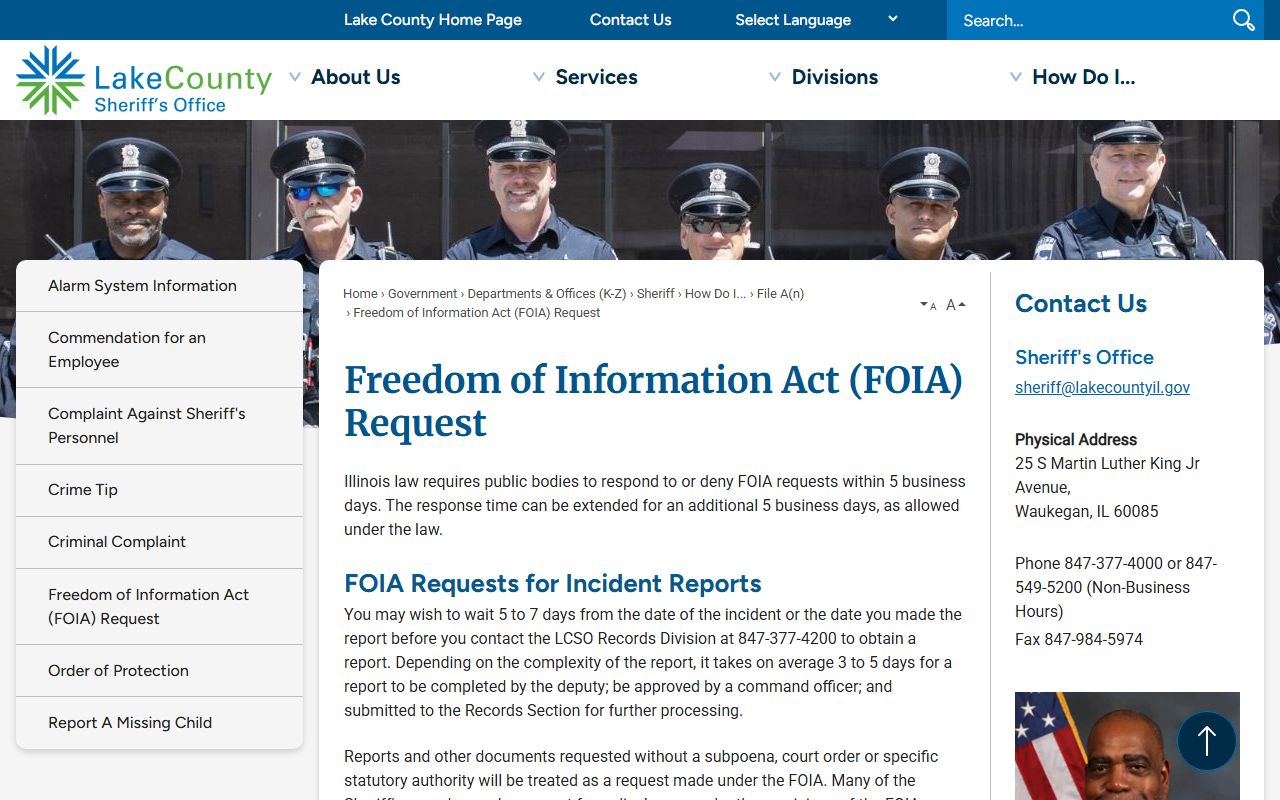
Your request should be in writing. Include names, dates, and as much detail as you can about the incident. Send it to the FOIA officer at the agency that holds the record. For the Lake County Sheriff, the FOIA page above has the contact information. The agency must respond within five business days. They get one five-day extension if they provide a reason. Under 5 ILCS 140/3, records are presumed public. Police blotter entries almost never qualify for an exemption because they contain basic facts about arrests and incidents.
The first 50 pages of black and white copies are free. After that, the standard fee is 15 cents per page. Electronic copies sent by email are usually free of charge. If a request is denied, the agency must cite a specific exemption from 5 ILCS 140/7. You can appeal any denial to the Public Access Counselor at the Illinois Attorney General's office.
Note: Lake County has one of the more organized FOIA processes in the state because of the volume of requests they handle.
Police Blotter Crime Data for Lake County
Crime data for Lake County is published through the Illinois Uniform Crime Reporting site. You can filter results by agency and see reported offenses, arrest numbers, and clearance rates for the Lake County Sheriff and for each municipal department. This gives a high-level view of police blotter activity across the county. The data is compiled from annual reports that each agency sends to the Illinois State Police.
The UCR data typically lags by a year or more. For the most current police blotter records in Lake County, contact the agency directly. The UCR site is best used for research, trend analysis, or comparisons between Lake County and other jurisdictions. All police agencies in the county must report under the Illinois Uniform Crime Reporting Act, so the data covers every department regardless of size.
What Lake County Police Blotter Records Show
A police blotter record in Lake County documents one event handled by law enforcement. It could be an arrest, a traffic accident, a domestic disturbance call, a theft report, or any other incident. Each entry has basic information: the date, time, and location of the event, the type of incident, and the names of people involved. If someone was arrested, the record lists the charges and any bond that was set.
Not all entries are arrests. A large portion of police blotter records in Lake County are calls for service where police respond but no one gets charged. Others are reports filed by victims of crimes. The blotter is a log of everything law enforcement does, not just the arrests. In Lake County, the volume of entries is high because of the large population and the number of agencies. A standard Lake County police blotter entry includes:
- Date and time of the incident
- Location or beat number
- Type of offense or call
- Names and ages of those involved
- Charges filed
- Case number and status
The format differs from one department to the next. The Sheriff uses its own system. Waukegan police have theirs. Highland Park and Libertyville each use different software. But the core facts in a police blotter entry remain the same across all Lake County agencies.
Local Police Departments in Lake County
Lake County has more than 40 municipalities, and most of them run their own police departments. Waukegan has the largest force. North Chicago, Mundelein, Highland Park, Lake Forest, Libertyville, Gurnee, Round Lake, and Zion all have their own departments. Each one keeps its own police blotter records. If the incident you are looking for happened inside a city or village, start with that town's police department rather than the county Sheriff.
Some smaller Lake County communities contract with the Sheriff for police services. In those areas, the Sheriff generates the police blotter records. If you are not sure whether an address is within a municipality or in unincorporated Lake County, the Sheriff's records staff can help you figure it out. This step prevents you from filing a FOIA request with the wrong office and having to start over.
The Illinois State Police FOIA page covers records from state troopers and state-level investigations. If a state trooper handled an incident in Lake County, the police blotter record would be with ISP, not with the local Sheriff or city police. That is a separate request process.
Cities in Lake County
Lake County has over 40 municipalities. The city listed below has its own page with details on how to search for police blotter records in that area. For other Lake County towns, contact the local police department or file a FOIA request with the appropriate agency.
Other Lake County communities with their own police departments include North Chicago, Highland Park, Mundelein, Libertyville, Gurnee, Zion, Round Lake, Lake Forest, and Grayslake. Each maintains separate police blotter records at the local level.
Nearby Counties
Lake County borders three other Illinois counties. If an incident happened near the county line, the police blotter record may belong to an agency in a neighboring jurisdiction. Verify the location before you file your request.